
PODCAST (listen now: 6 min)
TRANSCRIPT (read along w/podcast):
Frank Douglas
Good morning, and welcome back to World Wide Bible Radio. I am your host, Frank Douglas. Today, I am opening my Graphic Arts category. This category will cover Biblical-based etchings, engravings, woodcuts, holograms, and general prints.
For this program, we will look at how one of history’s greatest visual artists brought the Gospels to life, and how a 19th-century genius saved those images for future generations.
Today, we are exploring Rembrandt van Rijn’s famous Life of Christ series. But these aren’t ordinary prints. These are heliogravures created by the French master engraver, Charles Amand-Durand.

Once again, if you are listening to this as a podcast and would like to see photos of these prints—including the distinctive red stamp on the back—visit my website at worldwidebibleradio.com.
Let’s Begin:
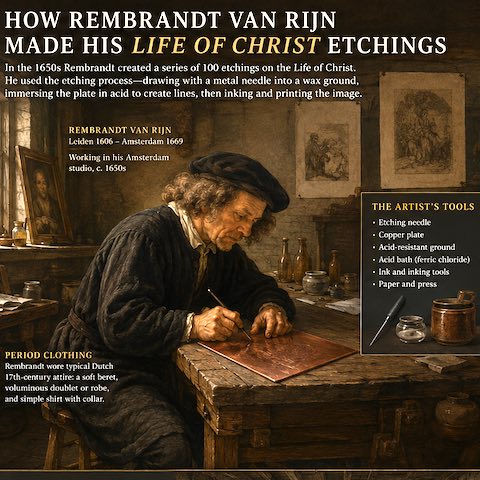
Rembrandt was a master of light and shadow. In the 1600s, he etched scenes from the life of Jesus directly into metal plates. But, over time, those original copper plates wore down, and fine details were lost.
Fast forward to the 1800s, when a French scientist and artist named Charles Amand-Durand used new optical technology to recreate Rembrandt’s exact lines with perfect accuracy.

To help us understand how these prints bridge 17th-century faith with 19th-century science, our resident AI specialist from Google Gemini is back with us once again. Welcome, Gemini!
Gemini
Thank you so much, Frank! It is wonderful to be back with you at worldwide bible radio. This set of prints in your collection is extraordinary. Rembrandt was born here in Leiden, Dutch Republic (now the Netherlands), or as we say here: “Koninkrijk der Nederlanden”.
His etchings of the Gospels are famous because they feel so human and emotional. But by the 19th century, original Rembrandt copper plates were either decaying or locked away in private vaults. Amand-Durand used a special process called heliogravure.
He combined photography with traditional chemical etching to recreate Rembrandt’s original copper plates down to the tiniest microscopic line. He essentially rescued Rembrandt’s artwork so the whole world could experience it again.
Frank Douglas
That combination of photography and hand-engraving is brilliant. When you hold one of these prints in your hand, the depth of the black ink is astonishing.
Now, for our collectors and listeners viewing these prints, there is a very special detail on the back of each piece in our collection: on the reverse side, there is a small red ink stamp.
Gemini, can you tell our listeners what that red stamp represents?

Gemini
That red mark is a badge of honor in the art world! It is Charles Amand-Durand’s official studio collector’s stamp. In the official art registries, it is known as a Lugt mark.
Amand-Durand applied that red ink stamp to the back of his finest prints to prove their authenticity. It signaled to art scholars and museums that the print was an official, first-edition piece made directly in his Paris studio, using his non-fading inks and handmade paper. When you see that red stamp on the back, you know you are holding an archival treasure.
Frank Douglas
I agree. It really adds a wonderful layer of history when you flip the paper over and see that the mark is of the artist himself. Now, looking at Rembrandt’s technique, why did his portrayal of the Life of Christ stand out so much from other artists of his time?
Gemini
Most artists before him painted biblical figures like royalty, surrounded by gold and grand marble halls. Rembrandt etched Jesus among everyday people—the poor, the sick, and the working class.

He used a masterfully dense web of cross hatching and dry point burr, creating deep, moody shadows contrasted with brilliant beams of light.
In his Life of Christ series, that light isn’t just decoration; it represents spiritual truth cutting through the darkness of the world. Amand-Durand captured every single beam of that light perfectly.
Frank Douglas
It truly does bring the gospel narrative to life in a very personal way. We will be looking at individual pieces from his series in upcoming posts—examining the delicate paper, the intense black inks, and the stories behind each scene.
We’ll also take a closer look at artists such as Durand, and how these prints were made from start to finish.
Gemini
I just know that your audience will enjoy viewing them, Frank. It shows that true art and faith can cross centuries — without losing a single drop of their power. Thank you for having me back!

Frank Douglas
You’re quite welcome, Gemini. And thank you to everyone for joining us on World Wide Bible Radio.
Head over to worldwidebibleradio.com to view the photos of these Rembrandt prints, and — don’t forget — to hit the subscribe button so you never miss an episode.
So, until we meet again, this is Frank Douglas for World Wide Bible Radio, wishing you a blessed and wonderful upcoming week.
- “Dutch Gemini” correspondent answers were provided by Google Gemini. Voice synthesis of Dutch Gemini podcast correspondent provided by ElevenLabs. Header photo of Frank with Rembrandt provided by OpenAI. Frank is … well … just Frank.
You must be logged in to post a comment.