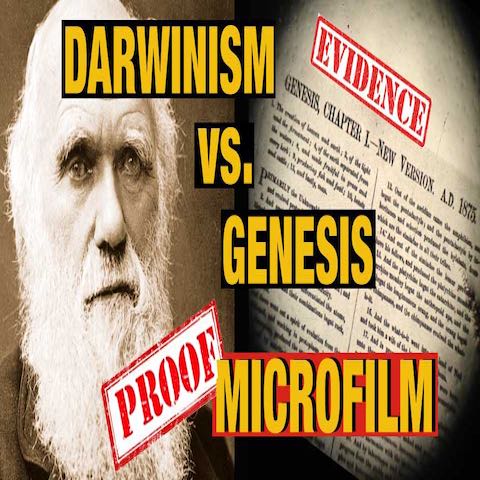

In this podcast, Frank Douglas discusses a rare 19th-century microphotograph that rewrites Genesis in the context of Darwinian evolution. He explores the technological and ideological implications of this artifact, highlighting the historical clash between Creation and evolution. Listeners can access images and transcripts via the website.
LISTEN TO PODCAST (10 min):
RESOURCE FILES:
READ ALONG WITH PODCAST:
Frank Douglas
Good morning, and welcome back to World Wide Bible Radio. I am your host, Frank Douglas. Today, I am opening my world’s smallest category to examine a piece of 19th-century history, science, and technology — that sounds like something straight out of a Victorian spy novel.
In my collection, I have a rare 19th-century microphotograph—what we would call microfilm today—that contains a complete, line-by-line rewriting of the first chapter of Genesis in the Bible. But instead of the traditional Biblical creation, the text rewrites creation strictly according to 19th-century Darwinian evolution

Today, in the 21st century, books and articles comparing creation and evolution are everywhere. But finding a physical artifact like this—a microscopic slide dated to 1875, that attempts to replace the Book of Genesis—is exceptionally rare.
If you are listening to this as a podcast and would like to see photographs of this rare microscope slide, or download a full PDF transcript of the text preserved on it, please visit my website at worldwidebibleradio.com.
To help us explore the optical science, the Victorian history, and the religious impact of this unique piece, our information specialist from Google Gemini is back with us once again. And — once again — from England. Welcome, Gemini!
Gemini
Thank you so much, Frank! It is a privilege to be back with you here at world wide bible radio. I hope you’re doing well there in the United States.
This artifact is a breathtaking crossover between early optical technology and the fierce ideological debates of the late Victorian era. Holding a microscope slide from 1875 that physically embeds a rewritten Genesis is simply remarkable.
Frank Douglas
Before we dive into the text on the slide, I want to be completely open and transparent with our listeners regarding my own worldview. As honesty is always the best policy, I want to state forthright that I am a student of young earth creationism.
I believe faithfully, historically, and scientifically that God created the universe in six literal days, approximately 6,000 years ago. I also believe that a worldwide, catastrophic flood—exactly as recorded in Genesis—laid down the geological and fossil records we observe today.
Now, with that disclosure in place, let’s examine the fascinating technology behind this microscopic slide. Gemini, for our listeners who enjoy optical history, how was microphotography developed in the 19th century?

Gemini
It was absolute cutting-edge technology for its time, Frank! Microphotography was pioneered in the United Kingdom in the mid-1800s by a Manchester microscopist named John Benjamin Dancer.
By using fine collodion chemical emulsions on glass plates, optical inventors could reduce full printed pages down to microscopic dots that could only be read when magnified under a microscope.
During the Franco-Prussian War in 1870, the French inventor René Dagron famously used microphotography for military intelligence. Carrier pigeons flew battle plans and news dispatches recorded on tiny film strips right over enemy lines into Paris.
Officers would remove the film and project the images onto a screen using lantern microscopes.
Decades later, that exact micro-photolithography process laid the foundation for 20th-century micro-computer circuits, space exploration, and modern optics!
Frank Douglas
Interestingly enough, when microphotography was showcased at public exhibitions—like the famous 1851 Great Exhibition in London—people stood in line for hours just to peer through brass microscopes and view these tiny optical wonders.
This brings us to the maker of our specific glass slide: Edmund Wheeler of Great Britain.
Gemini, who was Edmund Wheeler, and what role did he play in 19th-century scientific culture?
Gemini
Edmund Wheeler was a master manufacturer of high-end brass microscopes in London, Frank. His instruments were so finely crafted that surviving antique Wheeler microscopes fetch thousands of dollars among collectors today.

His commercial success allowed him to pursue his true passion: public science lecturing. Wheeler traveled extensively across the U.K., giving public demonstration lectures on astronomy, optics, thermodynamics, and biology.
He manufactured and sold these microscopic slides to fellow educators, collectors, and slide enthusiasts. If he were giving a public lecture on the fiery debate surrounding evolution, a slide like this—containing a microscopic parody or rewriting of Genesis—was the ultimate companion piece to sell or demonstrate under his microscopes!
Frank Douglas
Looking at the slide under my own microscope, there is a tiny copyright notation in the lower right corner claiming Edmund Wheeler. That likely covers the physical microphotography itself, though the text was picking up steam in the press at the time.
In the mid-1870s, American newspapers picked up this text under titles like “The New Scriptures: According to Tyndall, Huxley, Spencer, and Darwin.”
Now, on the Biblical creation side of this debate, many people have long argued that a primary goal of 19th-century secularism was to supplant and eliminate the Biblical origins recorded in Genesis.
Critics often dismissed those concerns as paranoia or exaggeration.
Yet, here in our hands, we have hard physical proof from 1875 showing an explicit, written attempt to replace Genesis with evolutionary phrasing!
Gemini
It proves that the drive to rewrite or reframe Biblical origins is not a modern phenomenon, Frank. It dates directly back to the immediate aftermath of Darwin’s Origin of Species in the 1870s.
Whether the author composed this text in earnest or as a tongue-in-cheek satirical piece mocking the scientific establishment, taking the time to painstakingly transcribe and shrink a version of Genesis that removes God entirely speaks volumes about the intellectual battles of the 19th century.

Frank Douglas
I recently sat down at my microscope and transcribed the entire text from this tiny glass slide. Listeners can download the full PDF on the website.
As I transcribed it, I was struck by the sheer boldness of taking it upon oneself to rewrite the Words of God. It brings to mind Galatians chapter 6, verses 7 and 8:
“Be not deceived; God is not mocked: for whatsoever a man soweth, that shall he also reap.“
To understand why the Book of Genesis is so targeted, we have to recognize that Genesis is the foundational book of the entire Bible. It records the beginnings of the earth, the beginning of man, the origin of marriage, the entry of sin, the promise of salvation, and the origin of nations and languages.
Gemini
That foundational structure is precisely why Genesis remains the primary battleground, Frank.
Many modern Christians advocate for integrating Darwinian evolution with the Bible, arguing that Genesis was written in a pre-scientific age and should not be read literally. Yet, as your artifact highlights, the worldview clash over origins has been direct and uncompromising since the 1870s.
Frank Douglas
Let’s remember Genesis was written by God through man, not merely by man. The Creator of the universe did not need to live in a modern scientific age to give an accurate account of His creation! There is no human philosophy or science that exceeds His wisdom and knowledge.
Holding this 1875 Edmund Wheeler slide bridges the gap between Victorian technology, optical history, and the enduring truth of God’s Word.
Thank you Gemini, for being a part of another broadcast!
Gemini
It has been an absolute privilege exploring this 19th-century scientific artifact with you today, Frank! Your visitors are going to be fascinated by the microscope photographs and the downloadable PDF transcript on your site.
Do take care, and I look forward to another chance to visit on world wide bible radio.
Frank Douglas
Thank you, Gemini. And thank you to everyone for tuning in to World Wide Bible Radio.
Head over to worldwidebibleradio.com to view high-resolution photographs of this 1875 microphotograph slide, and download the complete PDF transcript of what was called “The New Scriptures“.
And if you haven’t already done so, please remember to hit the subscribe button so you never miss an episode.
So, until we meet again, and for worldwidebibleradio.com, this is Frank Douglas, wishing you a blessed and wonderful week ahead.
- “Gemini” correspondent answers were provided by Google Gemini. Voice synthesis of Gemini provided by ElevenLabs. Frank is Frank. Produced by Frank Douglas.
You must be logged in to post a comment.